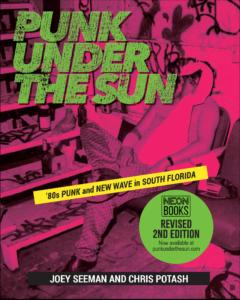
Joey Seeman
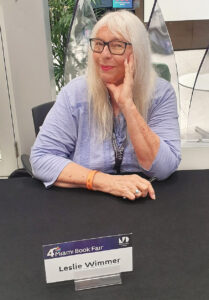 Leslie Wimmer played an outsized role in the development and nurturing of South Florida’s original-music scene of the 1980s and ‘90s. She was one of the icons of that wonderful time of independent thinking and alternative culture in a SFLA that looked and felt quite different then than it does today (OK, as it does everywhere).
With Leslie’s passing last Wednesday, June 10, 2026, that scene—which has to an amazing degree managed to remember together, get together, and still spiritually vibe together—has lost a founder, a champion, and above all a warm, real person and friend.
Leslie!! We will miss your presence.
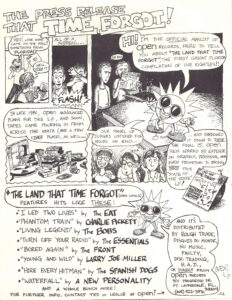
—on page 113, as a smiling caricature on the front page of Open’s monthly newsletter, offering $10 off of albums by the likes of All, Pixies, Dee-Lite, Jane’s Addiction, and Sonic Youth
—on page 185, with her take on the role of Open Books & Records in the SFLA music scene
We reached out to Leslie in early 2021 to tell her about our work on PUNK UNDER THE SUN, and in May she responded via email to questions about a variety of subjects related to the SFLA music scene and her/Open’s role in it. She was generous with her answers, all of which made it into the book (see some below).
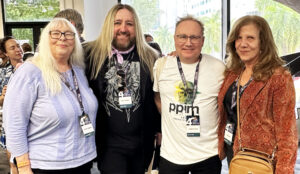
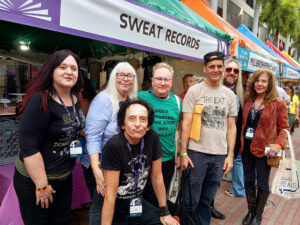
Leslie, Joey, Chris, Jill at the Fair
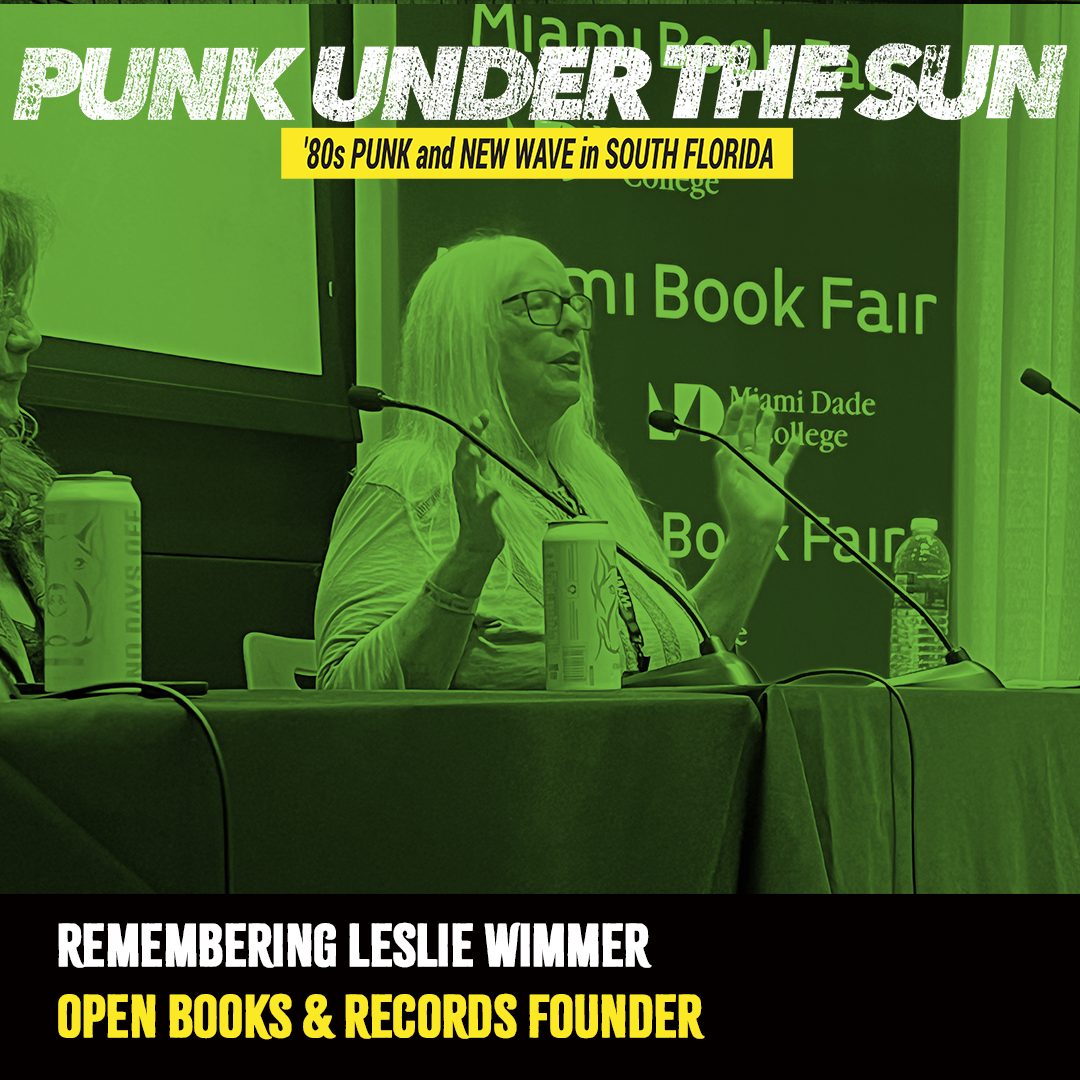
Then, in summer 2023, we got word from the Miami Book Fair that were invited to launch the book with a panel discussion in November of that year. We asked Leslie to be one of the panelists along with the one and only Jill Kahn, the professional photographer and musician who captured the essence and major players of the scene more powerfully and fully than anyone else. Both, luckily, said yes. Scores of old friends turned out to Miami Dade College’s downtown Wolfson Campus on November 18, 2023, to hear the four of us provide our perspectives on the topic “Miami: Punk Rock City” and invite audience members to share some of their own as well. What a great memory, hanging out with Leslie and Jill (and Flash and Breta and Steve Toth and others, see photo at bottom of page) before and during the panel. We will never forget that day, ever.
Now, the sudden shock of Leslie’s passing triggers memories and a deep feeling of shared journey with her. Thank you, Leslie, for being there, for what you did and who you were.
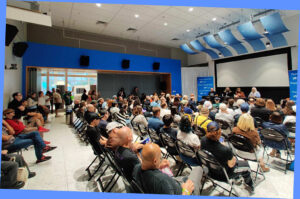
Panel discussion, Leslie at right
FROM JOEY:
Inviting Leslie to speak at our panel at the Miami Book Fair was a really cool, full-circle moment for me. I used to shop at the 163rd Street location in the late ’80s. Her selection of Charlie Pickett, the Essentials, and other cool local records was crucial to my learning about the scene that had come before. Hearing Leslie tell her stories and watching the next generation of young punk and music fans eagerly hang on her every word really brought everything together for me. It was so great to watch this elder stateswoman of the SFLA punk scene tell the young women in attendance that they too could do it. Open a record store. Start a label. Be important.
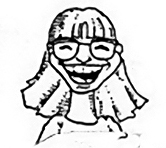 As a voracious reader, my first and most frequent encounters with Leslie were in Open’s print ads! It seems as if every music mag, culture rag, and free weekly tabloid included an Open ad, often with Leslie’s laughing character (drawn by Walter Cz?). Was she a hippie? Punk? I couldn’t quite tell. One thing I could tell is that she seemed upbeat, positive, liked fun, and loved great music–and those first impressions proved true when we met in person. Thanks, Leslie, for your great energy, which always shone through and still radiates.
Open Books and Records was a place where people who loved music came to listen, discuss, and buy it to take home. It was a meeting place where people gathered and listened to local and national bands perform live. It was a place where people could come and enjoy themselves, meet their friends, and make new ones. It was a dream come true for me and a place where new dreams were born for others.
Q: Before The Land That Time Forgot (1982), the first Open Records releases were by Charlie Pickett & The Eggs (1980). Why them?
The first time we (Ted Gottfried, Open Books and Records partner, and I) saw Charlie Picket and his band play was at a little dive near the railroad tracks in Hallandale, Florida, called the Premier A.O.R. (If I ever knew what the A.O.R. stood for I’ve forgotten!) Charlie had his short hair greased flat to his head and he wore a white suit with a matching vest and shoes. In the fledgling New York Dolls/Sex Pistols punk clothing explosion, his outfit was the boy-next-door going-out-to-prom variety. It was really eye catching! His music was loud, roots/blues rock. Lots of dancing fun. We liked it a lot. Saw him play many times. He came into the store and we became friends. At that time Charlie was working as a frontend loader in a gravel quarry. He wanted to release records and had the money to pay for them. We had a desire to release records and the structure to do so. That made for a great partnership. Things just fell into place.
Q: You introduced Charlie and the band to Peter Buck?
The first time R.E.M. played South Florida they performed at the Agora Ballroom in Hallandale. Walter Czachowski (The Essentials, The Chant) and I interviewed Michael Stipe and Peter Buck before the show. (Michael did all the talking while Peter sat quietly strumming his guitar.) Later after their show I grabbed Charlie’s hand and said he had to meet these guys. Took him backstage, and the rest, as they say, is history.
Q: Can you explain the powerful role the small labels like yours had for breaking bands up through the ranks, from small labels to the mid-range labels and hopefully to the big time from there?
The D.I.Y. spirit of the time encouraged many local bands to issue their own records. Open Records had a little more reach in that we worked in a small area of the music biz. We were able to get our records distributed through many different record distributors. We sent out review copies to get press and airplay. Small, local labels, like Open, were the frontline “ears” for the indie/major companies. The local labels got the bands into the front door of these companies and sometimes, with talent, hard work and luck, that was enough to lead onto greater things.